2026/05/29
Why Enterprise AI Adoption Fails — The Most Overlooked Reasons
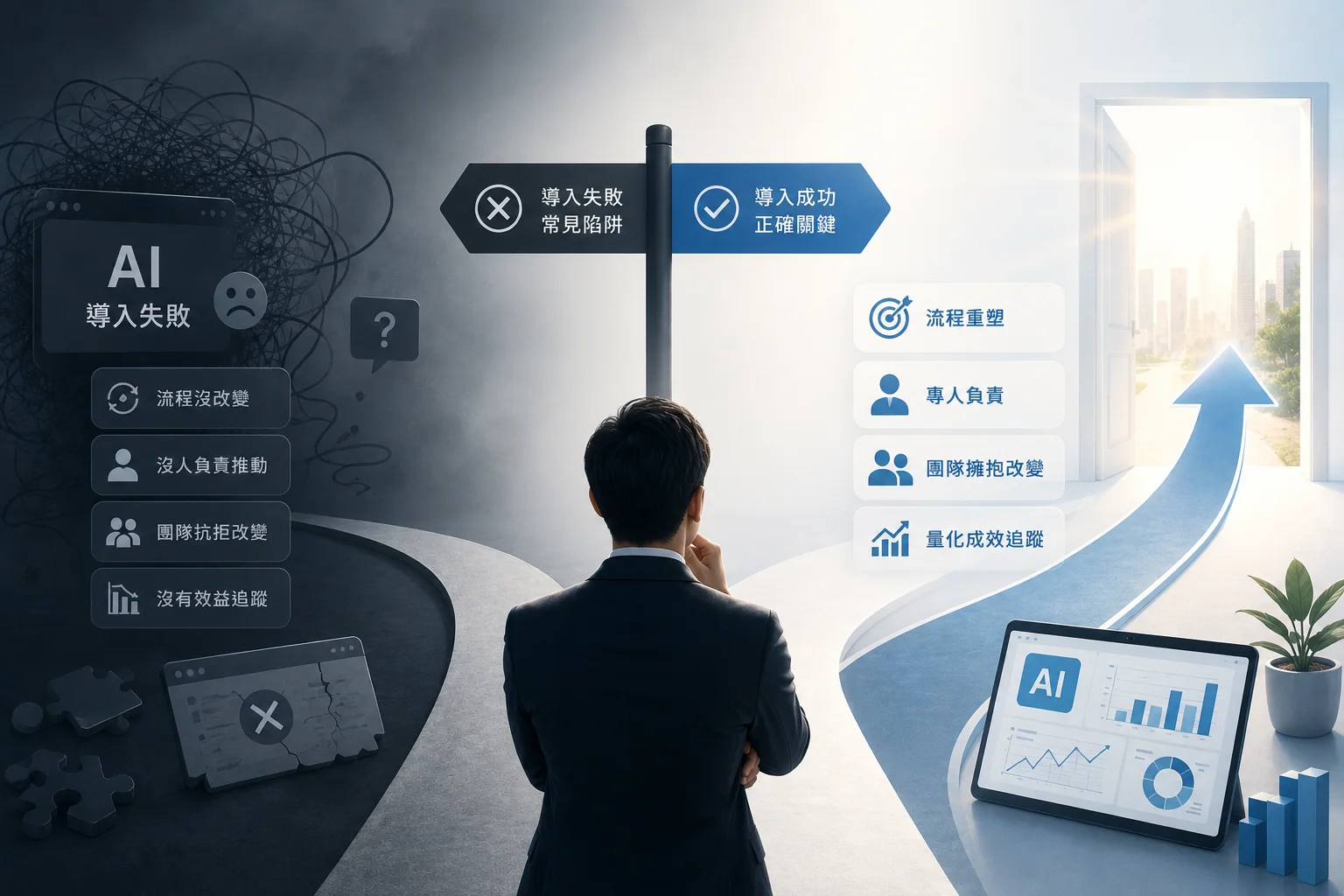
Most enterprise AI adoption failures aren't caused by immature technology or wrong tool choices. The real culprit is a serious disconnect between technology and process — unreshaped workflows, no one accountable for outcomes, and underestimated human adaptation costs. Rebuilding business logic is the only path to success.
If you are currently evaluating Software Development, or are in the planning stages but unsure of the direction, this article will help you clarify key points and risks.
We also offer free consultations. If you are looking for a quicker way to assess whether this solution is suitable for your specific situation, please feel free to reach out to us.
"We tried AI, but it didn't do much."
This is a phrase we hear often from business owners in Taiwan working through digital transformation. Yet every time we dig deeper, TWJOIN's technical consultants find the same answer: the AI technology itself wasn't the problem — the issue was everything around it.
When enterprise AI adoption fails, the AI is rarely at fault. The real culprits are invisible pain points lurking at the edges: workflows never redesigned, no one driving adoption, teams that never adapted. Without resolving the root causes, swapping out models or tools leads to the same outcome every time.
The direct answer: Why does enterprise AI adoption so often fail?
Most enterprise AI failures don't stem from immature technology or wrong tool selection — they stem from a serious disconnect between technology and process. Nine out of ten failure root causes come down to: existing workflows left unchanged, no one accountable for results, and the underestimated cost of human adaptation. Starting from business logic redesign is the only path to success.
The Tool Itself Is Usually Not the Problem
Today's AI technology — from large language models (LLMs) and SaaS automation platforms to bespoke software systems — is far more mature than it was just a few years ago. An AI system handling repetitive text tasks, given clear requirements and clean data, has a high technical success rate. So why does enterprise AI adoption still fail so often?
A Classic Failure Scenario from a Taiwan B2B Trading Company
A trading company deployed an AI auto-reply system to handle incoming inquiry emails from overseas clients. Technically, everything worked perfectly — the AI could parse email content, cross-reference a product database, and generate reply drafts with consistent accuracy.
Three months later, the system was shelved. The reason: the sales team had never integrated "reviewing AI drafts" into their daily workflow. Sales reps received drafts but weren't sure whether to trust them, so they rewrote everything themselves. No one decided who owned responsibility for the drafts. No one tracked how much time the system was actually saving. The technology became a software orphan.
Three Real Root Causes of Digital Transformation Stalls
Outdated Processes Left Unchanged — Just Adding a New Tool
This is the most common mistake. Companies bolt an AI tool onto their existing workflow and expect efficiency gains automatically, but the original workflow logic was never designed for AI.
- A concrete example: a company adopted AI for contract review, and the AI was accurate at flagging risky clauses. But the original process had the legal team reading entire contracts before weighing in. Post-AI, the process became "legal reviews the AI's highlights, then decides whether to read the original."
- That process was never validated as workable. Everyone used it differently — some fully trusted the AI flags, others ignored them entirely. No one ever knew whether the tool actually improved review quality. AI requires you to rethink the process itself before it can deliver value.
No One Is Accountable for the Adoption Outcome
Most AI adoption projects drift into a gray zone the moment the technical team announces "the system is live." The tech team steps back, the manager says "let everyone give it a try," and then nothing happens.
Successful AI adoption requires a "product owner" role. This person doesn't need deep algorithm knowledge, but must take ownership of three things:
- Ensuring the team actually uses the system in their daily work.
- Tracking usage metrics and real business outcomes.
- Having the authority to push cross-departmental adjustments when human-AI collaboration stalls.
If no one's KPI or personal goal is tied to your AI adoption after go-live, this project will almost certainly die quietly within six months.
Underestimating the Human Adaptation Cost
Introducing a new tool means asking people to change deeply ingrained work habits. This is often harder than fixing bugs. People's resistance to new tools isn't usually about being conservative — it's about three unanswered questions in their minds:
- Can I trust what this AI outputs?
- If the AI makes a mistake that causes a business loss, who's responsible?
- No one told me what's in it for me personally.
Until these three questions are answered, even the best tool won't gain traction. The solution isn't more boring training sessions — it's giving early adopters enough tolerance for mistakes, making internal success stories visible, and making "using AI" feel easier than not using it.
Technical Problems vs. Organizational Problems: How to Diagnose Where Your AI Adoption Is Stuck
If your AI project is already underway but feels like it's going nowhere, use the diagnostic matrix TWJOIN has assembled below to quickly identify where the problem lies:
AI Adoption Diagnosis Table
| Your Actual Situation | Problem Type | Recommended Next Step |
|---|---|---|
| AI output quality is unstable or error-prone | Technical | Re-examine data quality, prompt configuration, or redefine underlying requirements |
| AI output is decent, but nobody in the office is using it | Organizational | Clarify the usage workflow, assign a dedicated owner, start tracking usage rates |
| The system is live, but you don't know if it's working | Organizational | Go back and define quantifiable success metrics and measurement methods |
| Tech team says it's fine; business teams feel no difference | Process | Redesign the business process so AI output feeds directly into core work nodes |
| Everyone says it's useful, but operational metrics haven't moved | Goal alignment | Confirm whether the AI is actually solving a true business bottleneck |
Four Actions to Take Before You Launch
Technical issues can be fine-tuned after launch, but if organizational problems go unaddressed at the outset, the cost of correction will be ten times higher later. TWJOIN strongly recommends completing these four actions before any AI customization project or transformation initiative begins:
Action 1: Designate one person accountable for outcomes
This person doesn't need a technical background, but must have sufficient cross-departmental influence and must make AI adoption effectiveness a core personal work objective.
Action 2: Redraw the business process flowchart before launch
Map out the entire workflow where you want AI to intervene, then ask: "When AI produces output at this node, who picks it up? How? What happens next?" Write this out in plain language — that's what it means to complete process design.
Action 3: Involve early users — including skeptics — in the design
Identify the person on your team most likely to resist new tools and invite them into the design phase. On one hand, you'll hear the most honest pain points about the workflow. On the other hand, after go-live, they'll become the most credible internal advocate — because this is a tool they helped improve.
Action 4: Set a 30-day success benchmark
Instead of setting ambitious goals like "reduce headcount by X," ask: "In the first 30 days, how will I know this is heading in the right direction?" It might be hitting 70% system adoption, or seeing a specific reconciliation error rate start to fall. With a short-term benchmark, you can iterate quickly and course-correct in the early stages.
FAQ
Q1: Our AI project already failed once. How do we start over?
Answer: Begin with a post-mortem analysis, objectively categorizing the failure causes into three buckets: technical problems, process problems, organizational problems. In TWJOIN's experience supporting AI adoption across many companies, technical problems are usually the smallest category. Identify and resolve the organizational and process blockers first, then decide whether to re-initiate the technical integration.
Q2: No one in our company has a technical background. Can we still drive AI adoption?
Answer: Absolutely. The technical development and API integration (such as Microsoft Azure OpenAI integrations) can be safely entrusted to an external professional software firm. But remember: business process redesign and internal change management can only come from within your organization. External consultants confirm technical feasibility and help design a smooth user experience — but the key driver of team adoption is internal leadership.
Q3: Will our employees be replaced after AI is adopted?
Answer: In the short term, what gets replaced is never "people" — it's "repetitive low-value work." For example, if a customer service representative spends 60% of their day answering the same basic return and exchange questions, AI adoption eliminates that 60% of inefficient work. That frees them to be redefined around higher-value service — building long-term client trust and handling complex cases that require human judgment.
Q4: Can small and medium-sized businesses maintain a customized AI system on their own?
Answer: It depends on your technical approach. Application-layer systems that connect directly to external public APIs have a relatively low maintenance threshold. However, for systems involving core business confidentiality and requiring high levels of customization, it's advisable to choose an external software firm with a long-term partnership structure from the outset, ensuring the system can be continuously maintained and iterated.
Q5: How do I convince leadership or the board that AI adoption is necessary?
Answer: Don't start with "this AI model is incredibly powerful" — leadership won't understand it, and even if they do, they won't care. Start directly from specific business numbers and pain points: "Our overseas inquiry process currently consumes X hours of labor per month, leading to a Y% lead leakage rate. If we solve this through a custom system, we estimate an improvement in conversion rate worth approximately Z ten-thousand NTD annually." Numbers speak. Technical jargon doesn't.
If you're facing AI adoption challenges — or feel stuck after going live — contact TWJOIN. We offer a complimentary first consultation to help you identify the root cause and redesign the process so your AI investment actually delivers results.
👉 Learn about our AI Custom Development services👉 Or contact us directly